
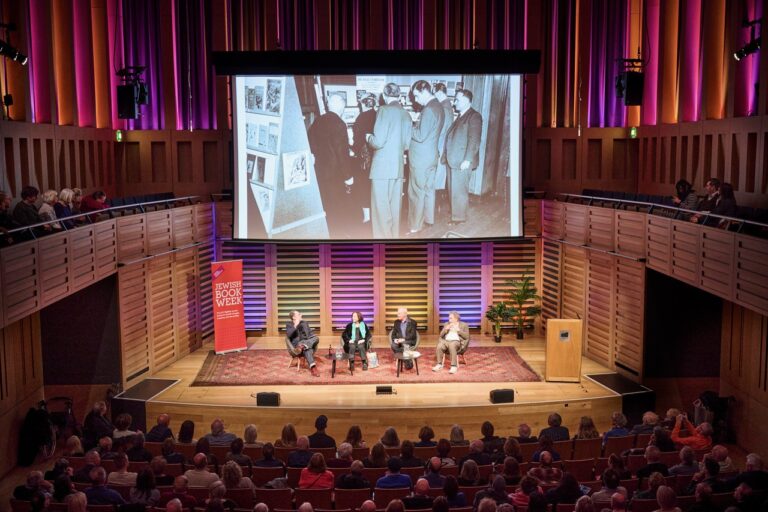
Seventy-five.
In Jewish life, that’s barely middle-aged. We don’t really get going until at least eighty. But seventy-five is a serious number.
In the Book of Genesis, Abraham was seventy-five years old when he left Haran and set out towards Canaan – seventy-five when he began the journey that would set the Jewish story in motion. So seventy-five is not a culmination. It is a moment to pause and reflect. A moment to ask: what’s our purpose? What are we for?
Why, seventy-five years after George Webber founded Jewish Book Week, haven’t we folded away the chairs, closed the books and gone home? The answer lies in another question: what does it mean to be a Jew?
There is a scene in Fiddler on the Roof when the Rebbe tells his student that there’s a blessing for everything. One of the students asks him, “Rebbe, is there even a blessing for the Tsar?” The Rebbe replies, “Of course… May God bless and keep the Tsar… far away from us.” It’s witty, but it’s also wise. The Rebbe doesn’t deny the reality of pogroms. He simply refuses to let the fear of pogroms define all Jewish life. This distinction is fundamental.
Recently, the American-Jewish commentator Bret Stephens, in his State of World Jewry address, made a stark argument: antisemitism cannot be educated away. Hatred is not cured by better information. Holocaust education does not guarantee Jewish security. Stephens argues that, while we can’t control how others see us, we can decide how we see ourselves. Jewish thriving should depend on Jewish learning, Jewish culture and Jewish values being not marginal to our lives, but central to them. That is why the Jewish Literary Foundation exists, and why we’ve held this festival every year since 1952.
If I had to describe our mission in one line, I’d say this: we are a yeshivah for the secular Jewish mind. A place where Jewish history, literature, music, argument and imagination are explored without dilution and without dumbing down. We’re here so that people do not simply feel Jewish in a vague or inherited way. We’re here for people to think Jewish, to ask Jewish, and to know Jewish.
And that invitation is not only for Jews. Around a fifth of our speakers and audience are not Jewish, but are drawn to Jewish ideas. That’s not a contradiction. Jewish civilisation has always been in conversation with the wider world. My stepfather was once studying a page of Talmud whilst sharing a train carriage with a distinguished Jewish historian. The historian, who’d spent his entire professional life studying antisemitism was bemused. “Why are you bothering with that?” he asked. My stepfather replied: “Because I’m a Jew.”
Seventy-five years ago, George Webber understood that engagement with the Jewish literary tradition is not decorative: it’s foundational. Our culture is not an extra: it is the basis of our continuity.
So why are we still here?
Because Jewish history carries on.
Because Jewish creativity continues to thrive.
Because Jewish questions still matter – usually more than the answers.
Because seventy-five, in Jewish terms, is just a warm-up.
Like Abraham leaving Haran at seventy-five, we step forward – not because we need to leave, but because we have somewhere better to go.
Welcome to Jewish Book Week at 75, and thank you for your support. Like all the best books, we’re only just getting to the good parts.